


20th-century Italian literature
Cesaretti Library

Volumes of editorial relevance and cultural interest
The section dedicated to twentieth-century Italian literature collects works that have profoundly influenced the culture and thought of the last century. Novels, essays and critical texts testify to the evolution of the language, themes and literary trends who lived through one of the most complex and fertile periods in Italian history. The catalogue offers volumes selected for editorial relevance and cultural interest, addressing scholars, collectors and enthusiasts.
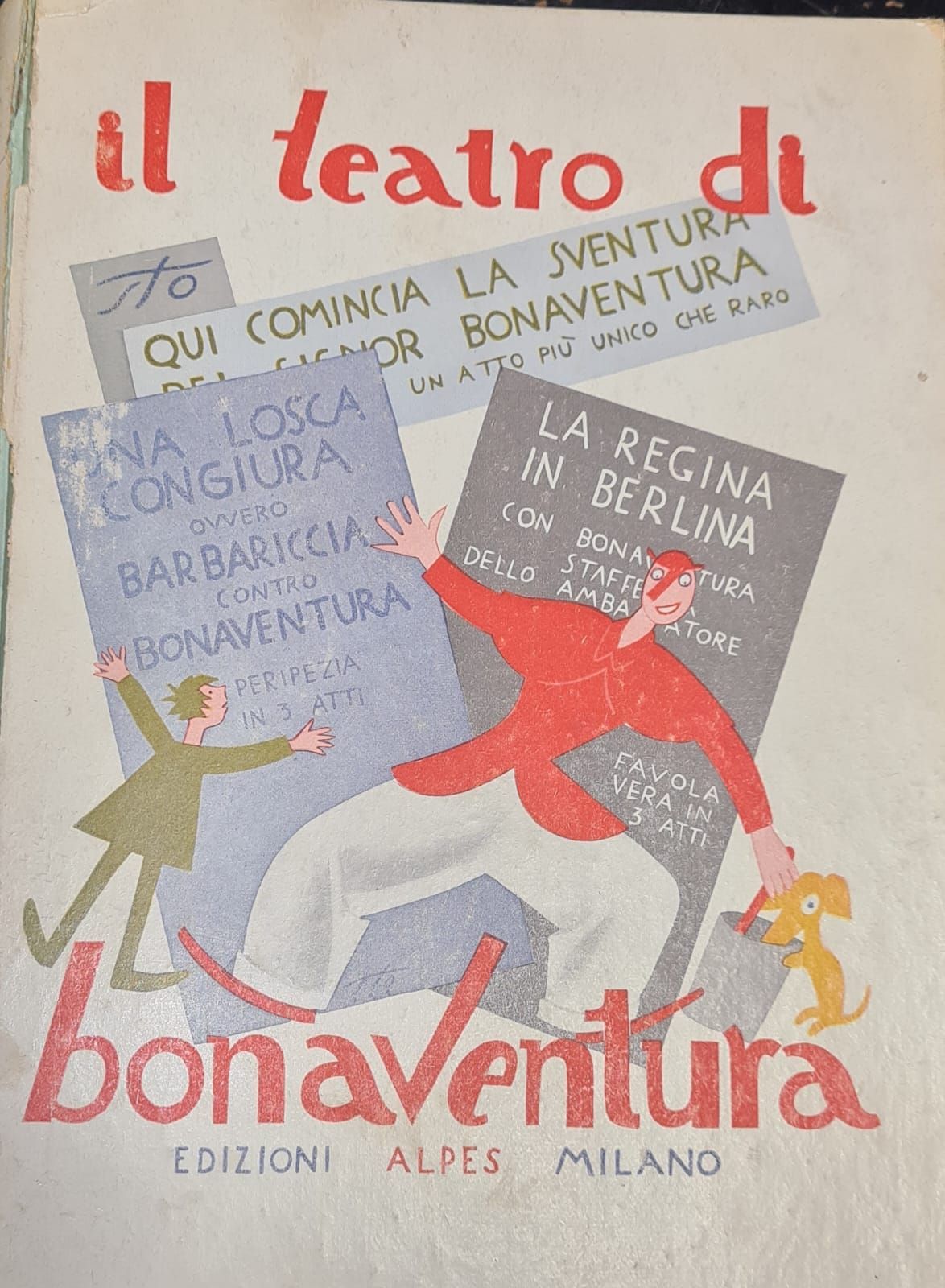
The Bonaventura Theatre
Author: STO (Tofano Sergio)
Publisher: Milan, Edizioni Alpes, 1930 (finished printing on November 28, 1929).
Info: 21.5cm, 410 pages
With 14 black-and-white illustrations and 8 color illustrations by the author and Rosetta. Editorial illustrated cardboard binding. Minor wear to the spine and corners of the binding, with signs of wear to the hinges.
Overall genuine specimen and in more than good condition.
Read more
A rare and sought-after first edition of this famous collection of plays by the great Roman cartoonist and writer Sergio Tofano (1886-1973). Contains the following comedies: Una losca congiura ovvero Barbariccia contro Bonaventura, unpublished and in its first edition (performed in Rome on 28 February 1929); La regina in berlina con Bonaventura corrietta dello mballo, already published in the Corriere dei Piccoli in 1928; Qui comincia la sventura del signor Bonaventura, already published in a volume in 1927. The first and most famous anthology dedicated to the theatrical mask of Bonaventura, which debuted in the pages of the Corriere dei Piccoli in 1917. See Gambetti-Vezzosi, Rarità bibliografiche del Novecento italiano, p. 917: "Uncommon and highly sought-after".
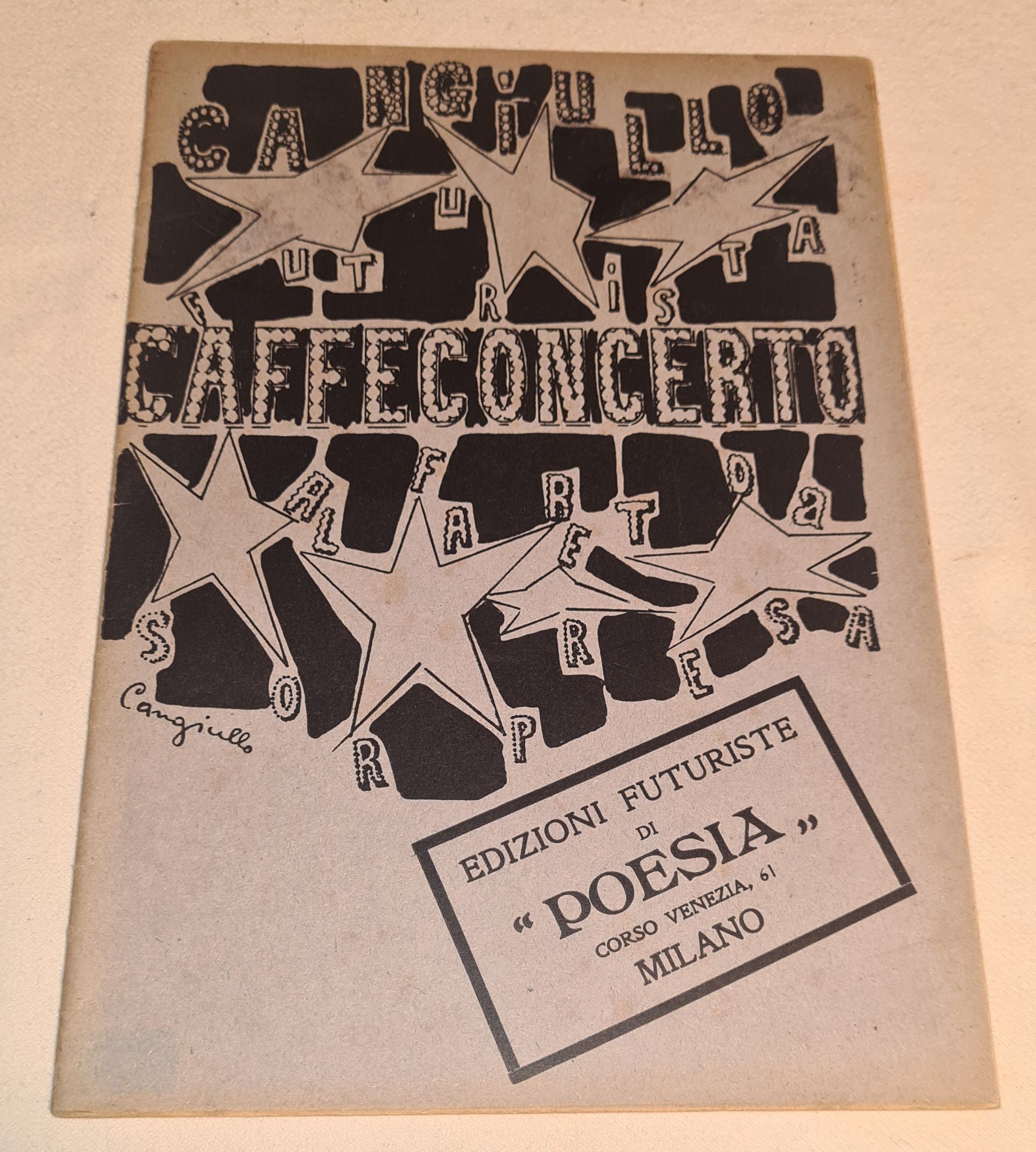
Café Concerto. Surprise Alphabet. 1919.
Author: Francesco Cangiullo
Specimen in excellent condition.
Original edition, entirely illustrated and free-form, printed on paper of various colors. The book is composed like a variety show, with an introductory set of fake advertising posters. The program is divided into parts, for a total of 16 segments, designed with an unprejudiced free-form approach, where the letters are distorted to outline figures and profiles.
Read more
See Salaris, Storia, p. 106; Hulten, Futurismo & futurismi, p. 439; Cammarota, Futurismo, 76.14. Francesco Cangiullo (Naples, 1884 - Livorno, 1977) joined the Futurist movement, of which he became one of the major exponents, in 1905, on the occasion of an "evening" at the Mercadante organized for the arrival of Marinetti, Palazzeschi, Altomare, Mazza and the painters Boccioni, Carrà and Russolo. Creator of experiments with free words, visual and sound dynamics (from humanized letters to the surprise alphabet), he published his first Futurist work "Le Cocottesche" in 1912, followed by Caffè Concerto (1919), Poesia Pentagrammata (1923) and the collaboration with the Futurist magazine "Lacerba" (1913 - 1915). Cangiullo, together with Marinetti, signed the "Manifesto of the Theatre of Surprise" (Il futurismo magazine, January 1922), a project he attempted to implement and promote during his tour with R. De Angelis's theatre company. These experiences were later recalled in the volume "Novelle del varietà" (1938). His gradual return to a more traditional poetry and his slow detachment from futurism were narrated in two of his last works, "Serate futuriste" (1930) and "Poesia innamorata" (1943), a synthesis of his poetic production after 1919.
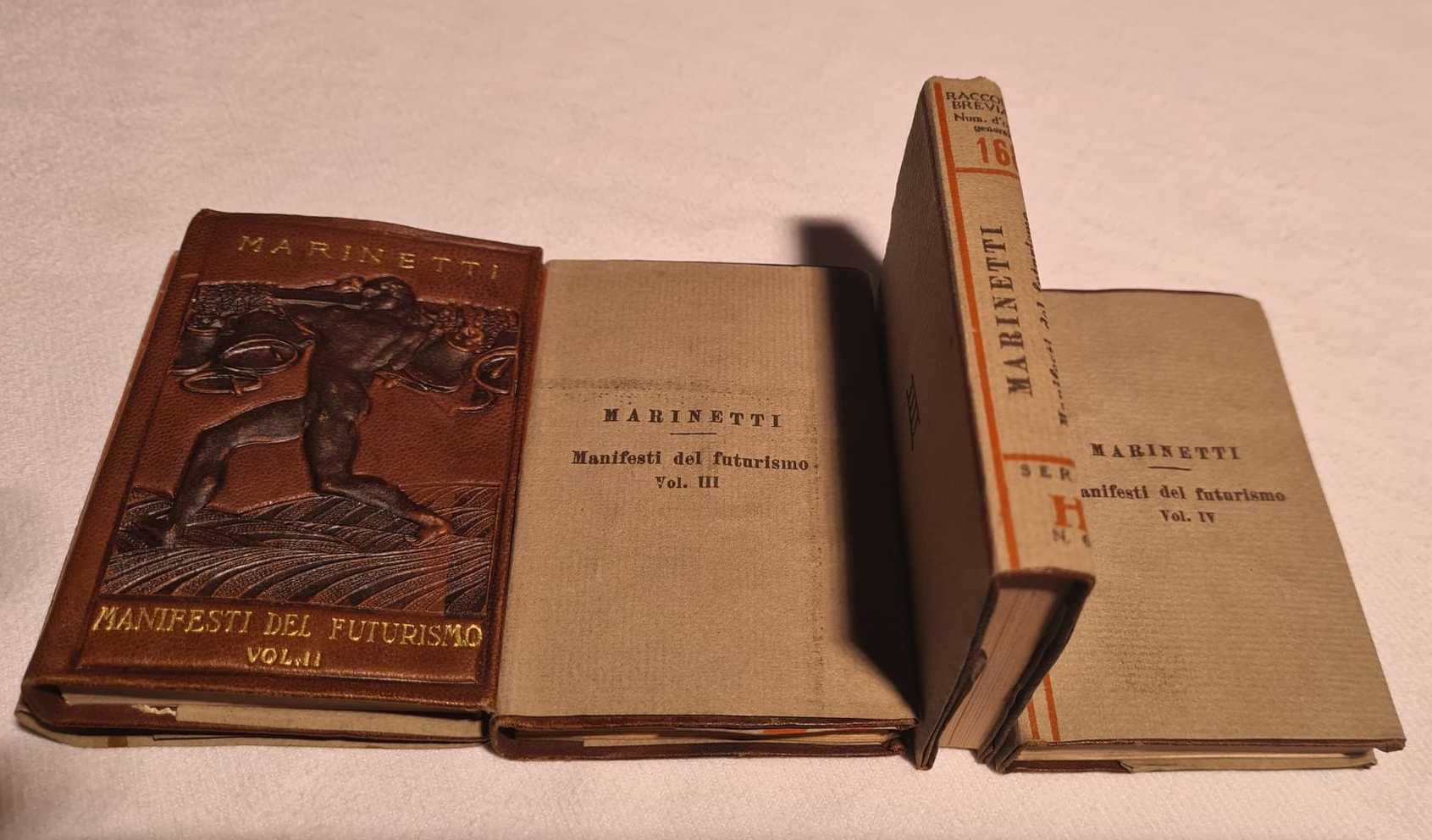
Manifestos of Futurism
AuthorFilippo Tommaso Marinetti
Publisher: Italian Publishing Institute, sd (1919)
Characteristics: 4 volumes, full leather binding, with dust jacket
Perfect condition. Extremely rare.
During its time in the artistic world, the Futurist avant-garde promoted several manifestos. In fact, in 1909 Filippo Tommaso Marinetti published the official edition of the new avant-garde in the French magazine “Le Figarò.” The following years saw the introduction of other manifestos written by other members of the group, especially in the first decade of the group's life, which is commonly considered the most prolific.
Read more
The manifesto thus became the main way for the Futurists to communicate their ideas and their cultural action, later inspiring the other avant-gardes that were beginning to spread throughout the European continent. However, Marinetti deserves the credit for having been able to give the manifesto the dignity to be considered a true literary genre.
In particular, there were three collections of futurist manifestos:
1. The first in Florence in 1914 with “The Manifestos of Futurism” with Lacerba edition;
2. The second in Milan in 1917 with “Noi futuristi” with Riccardo Quintieri Editore;
3. The third and final one, "The Manifestos of Futurism," was published in Milan in 1919 by the Italian Publishing Institute. This particular collection was divided into four volumes, totaling fifty-nine documents, all written and edited by various members of the group, although Marinetti always remained the primary voice. In addition to the manifestos, whose primary objective was to establish for the group and to explain to readers the rules and techniques necessary for the new artistic languages of literature, painting, sculpture, architecture, music, theater, and cinema, there were also other documents that addressed secondary themes such as food (they invented a patty of various types of meat and cheese), clothing, fashion (which for them, however, was dictated by purely geometric and rational lines), war, machinery, and modernity in general, all of which, however, ultimately led to a political landscape.
Although all these manifestos addressed completely different themes and addressed seemingly irreconcilable issues, it's easy to perceive a unified and recognizable style and spirit, typical of the Italian Futurist avant-garde. This unified spirit is particularly evident and perceptible in the application of the same basic principles of their ideology, always following a style that has always been considered polemical, scandalous, and peremptory.
Unlike the other avant-gardes of the time, which tended by definition to focus on and intervene in all strictly cultural and artistic fields, Futurism distanced itself.
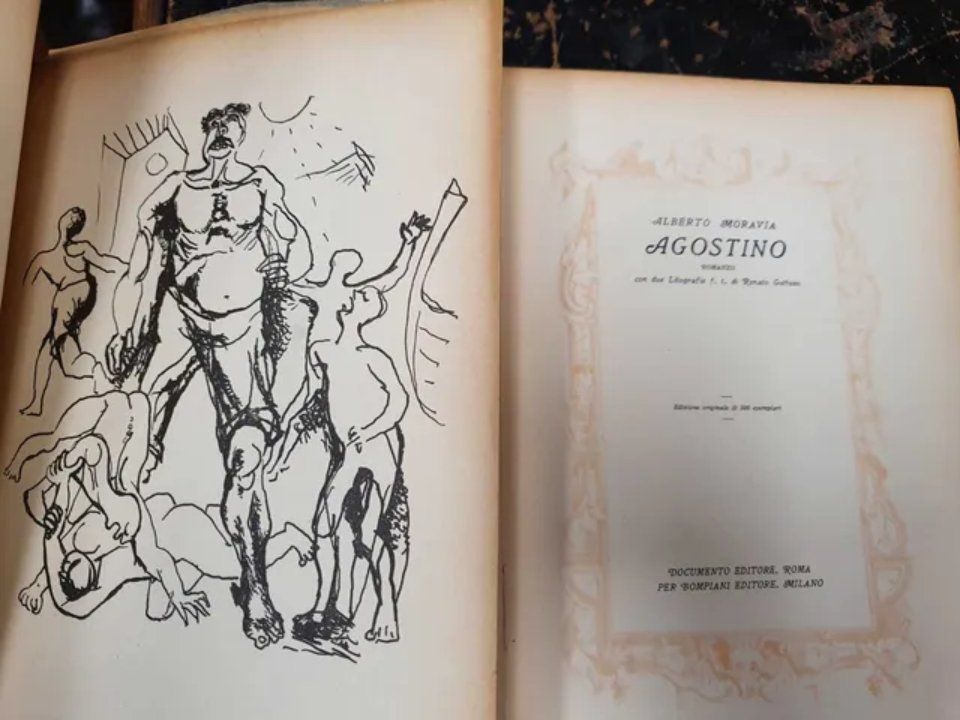
Agostino
Author: Alberto Moravia
Publisher: Publisher's Document for Bompiani Editore Milan, Rome, 1944.
Original edition of 500 copies.
Editorial cloth and cardboard binding with a small engraving by Luigi Bartolini. Fourth volume of La Margherita edited by Federigo Valli. Blind stamp on the title page and on the lithographs. Original edition of Moravia's work in excellent condition.
With two lithographs by Renato Guttuso.




