Right
Cesaretti Library

Texts relating to the history of law and legal disciplines
The law section includes legal texts, treatises and reference works which testify to the evolution of legal norms and thought. The volumes present offer useful tools for the study of history of law and legal disciplines in different eras.
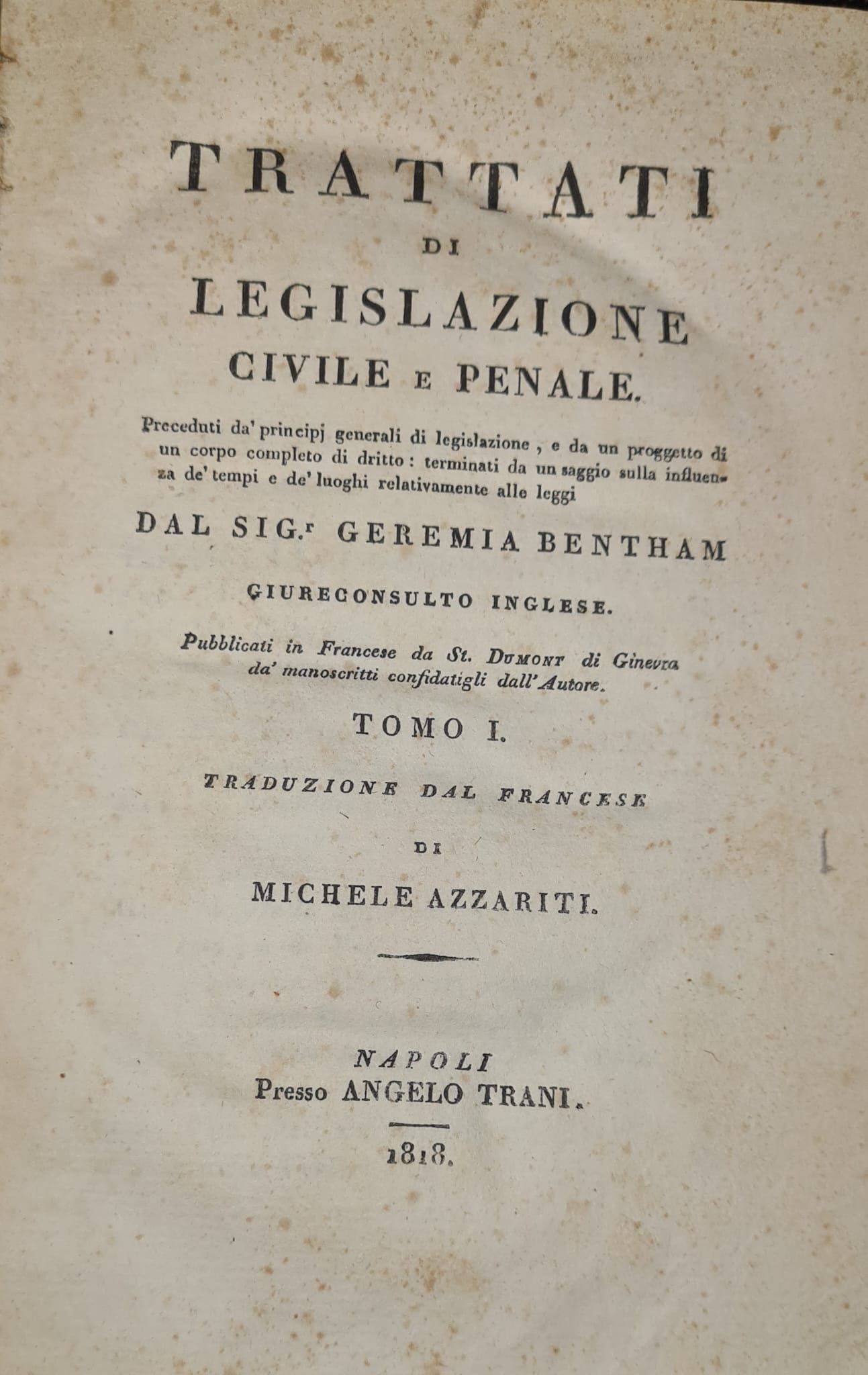
Treaties on civil and criminal legislation
Autore: Jeremy Bentham
Preceded by general principles of legislation and a draft of a complete body of law; concluded by an essay on the influence of time and place on laws. Published in French by Sir Dumont of Geneva from the manuscript entrusted to him by the author. Translated from the French by Michele Azzariti. Naples: Angelo Trani, 1818.
VIII 432 (2); XII 484; XI 504 pages 3 vols. 202x134 mm. Contemporary half-leather binding with gold titles and decorations on the spine.
Very good specimen.
Read more
First Italian edition of Bentham's Theory of Legislation, originally published in French, edited by Etienne Dumont from Bentham's original manuscripts. This work did more than any other to establish Bentham's reputation. It consists partly of Bentham's own papers, some of which were originally composed in French, and partly of Dumont's summary of Bentham's ideas. "Romilly tells an amusing story of Bentham's impatience to see the volumes because of a great curiosity to know what his views were on the subjects Dumont discusses. The success was immediate, and translations into Russian, German, Spanish, and Portuguese soon followed, and Bentham's influence became particularly marked in the South American republics, where 40,000 copies of various works were sold." (Muirhead)
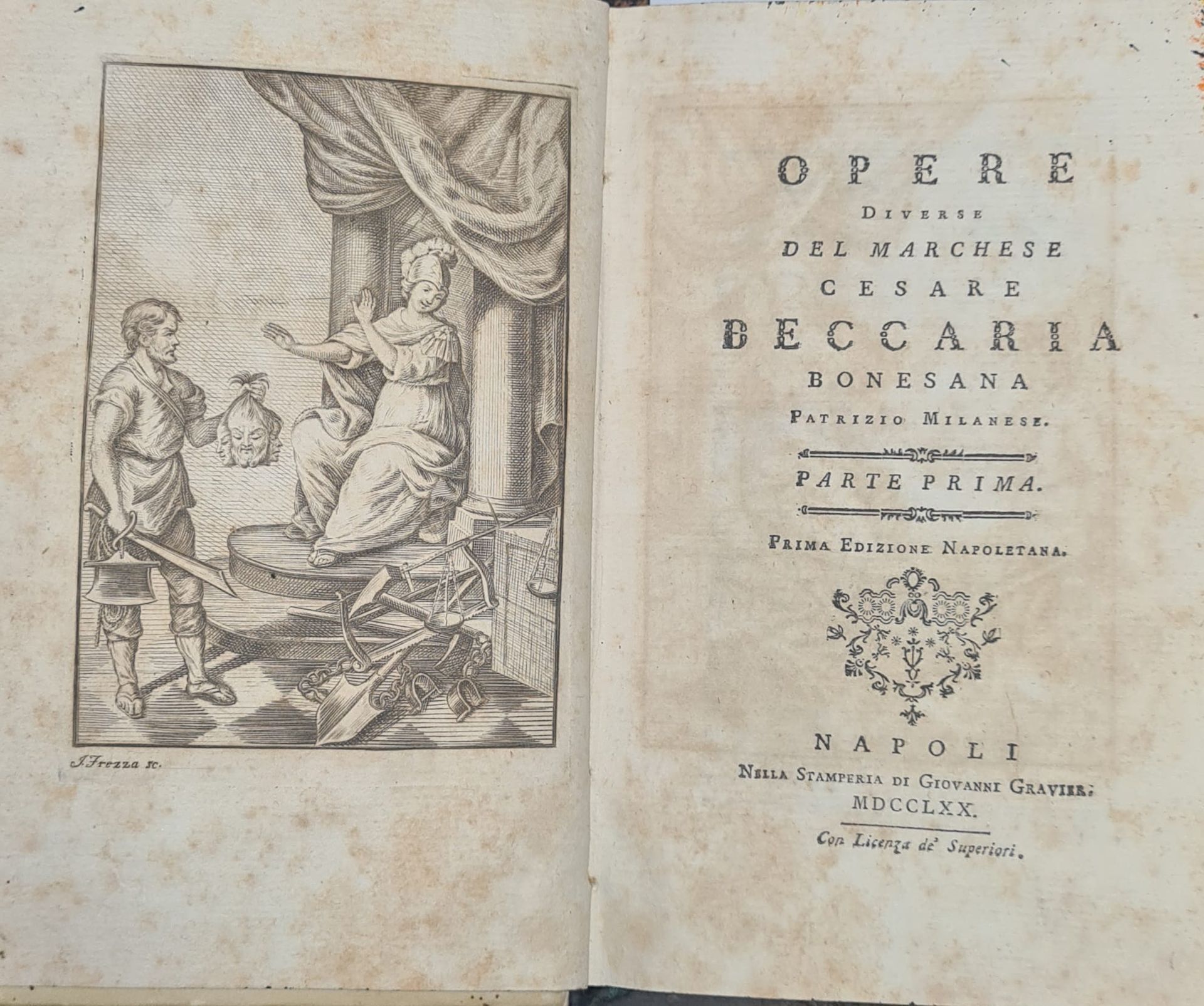
Various works by the Marquis Cesare Beccaria Bonesana
Author: Cesare Beccaria
Naples, Gravier, 1770-71
Part One (Second, Third) - First Neapolitan Edition.
Three parts in two volumes (13 x 21 cm); beautiful contemporary full parchment binding with gilt title on the spine; some stains and browning. The first volume contains the first part; the second the other two parts.
Each part has its own title page, but the works in the second volume also have further independent title pages.
Read more
Part One: [14], 316, [4] pages Engraved frontispiece by Isidoro Ferrara with Justice seated on the throne and rejecting the offer of the severed heads from the executioner - Contains: On Crimes and Punishments. Following: (Pietro Verri): Responses to a paper entitled Notes and Observations on the book On Crimes and Punishments. Following (Giovanni Gualberto Soria): Opinion of a famous professor on the book On Crimes and Punishments. Following: Commentary on the book On Crimes and Punishments by Mr. Voltaire.
Part two: [4], 128 p. and 6 tables folded out of the text. Contains: Inaugural address read by the royal professor in the Palatine schools, Marquis Beccaria Bonesana. On the disorder and remedies of the coins in the state of Milan in 1762. by Marquis Cesare Beccaria Bonesana, a Milanese patrician.
Some articles excerpts from the work entitled Il Caffè written by the Marquis Cesare Beccaria Bonesana, a Milanese patrician.
Part Three: [4], 178, [2] p Contains, with its own frontispiece, · Research into the nature of style. By the Marquis Cesare Beccaria Bonesana, a Milanese patrician. Part One. (The only one published in these Works).
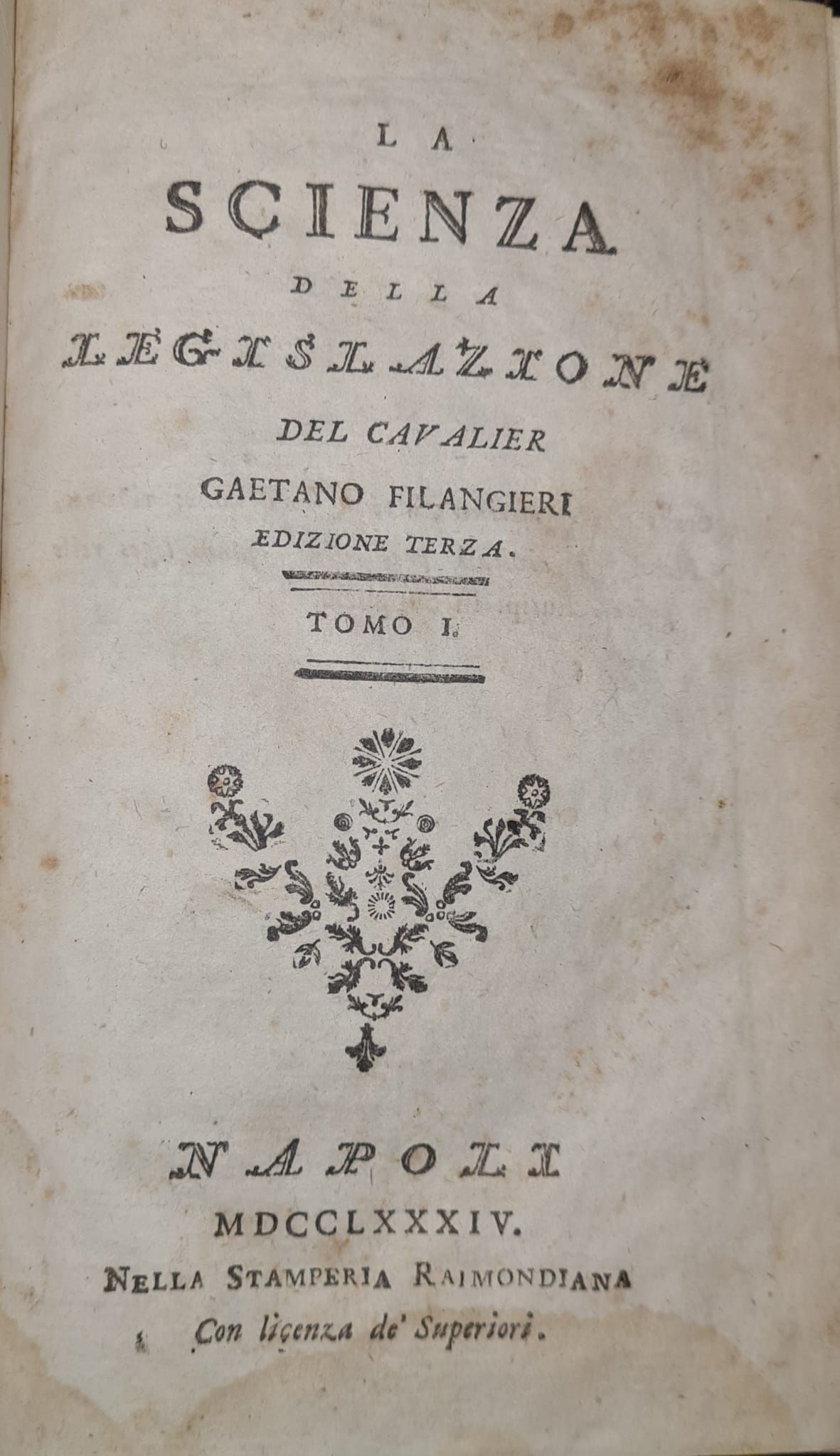
The science of legislation
Author: Gaetano Filangieri
Naples, Raimondiana printing house 1784-1791.
Bound with: Donato Tomasi, historical eulogy of the knight Gaetano Filangieri, Naples 1792.
8 volumes in 8° bound in 5 tomes, in full hard parchment with leather binding on the spine and gold lettering. Pp. 276, 410 (2 cc.nn), 408, (1) 548, 192, 250, 184, 304 (2 cc.nn), and 1 volume of identical format and in the same binding, of pp. (1) 208.
The volumes are part of the third edition, as written on the title page, certainly of the first two volumes, while the third to seventh, although written "third edition", are in reality probably the first edition, but by republishing the first two volumes with the writing "third edition", this writing was also maintained in the other volumes, while the eighth volume here is certainly the first edition (1791) and was published posthumously. The fact remains that determining the exact sequence of editions of Filangieri's masterpiece is a puzzle that is still largely unsolved. This is a beautiful set, embellished by Filangieri's historical eulogy.
Some browning and some scattered reddening, but more than a good edition, very rare.
Read more
Edition with additions and changes compared to the first one in Naples in 1780 of one of the major works that served Benjamin Franklin in drafting the Constitution of the United States of America.
"The Science, opposed by Neapolitan ruling circles and condemned in 1784 by the Congregation of the Index, immediately enjoyed enormous success in Italy, with testimonials of esteem from eminent contemporaries such as Bianchi and Pietro Verri (who wrote: 'I heard the voice of Hercules in the pages of the Science of Legislation'), and equally significant success in Europe, with praise from the Economic Society of Bern (a renowned center of Physiocratic culture) and translations into German in 1784, French in 1786, Spanish, and—partial—Russian and Swedish. Franklin repeatedly received copies of the various volumes of the Science thanks to Luigi Pio, secretary of the embassy of the Kingdom of Naples in France.
Franklin's interest also had operational implications: he considered Filangieri's work a model to inspire both the drafting of criminal legislation in Pennsylvania and the more challenging task of drafting the Constitution of the new federal state. A correspondence was established between the two, and Franklin sent Filangieri the text Constitutions des treize États-Unis de l'Amérique (The New World and the Civil Virtues, 1999; Embassy of Italy 2011). The copy annotated by Filangieri (like the initial drafts of two other projects: Nuova scienza delle scienze and Istoria civile e universale perenne) was lost, perhaps destroyed in the sacking and burning of his palace that followed the fall of the Neapolitan Republic in 1799.” (Adriano Giannola, in Enciclopedia Treccani sv Filangeri).
Gaetano Filangeri (1752-1788) can be counted among the most important Italian thinkers of the eighteenth century. Particularly attentive to the changes taking place in Europe and beyond, he developed a political and cultural position that was undoubtedly progressive, yet in stark contrast to the court and a large segment of the Neapolitan nobility. A keen listener to the French and Lombard Enlightenment thinkers, a friend and correspondent of B. Franklin, he always maintained his own independent thinking, which he rigorously presented in this work.
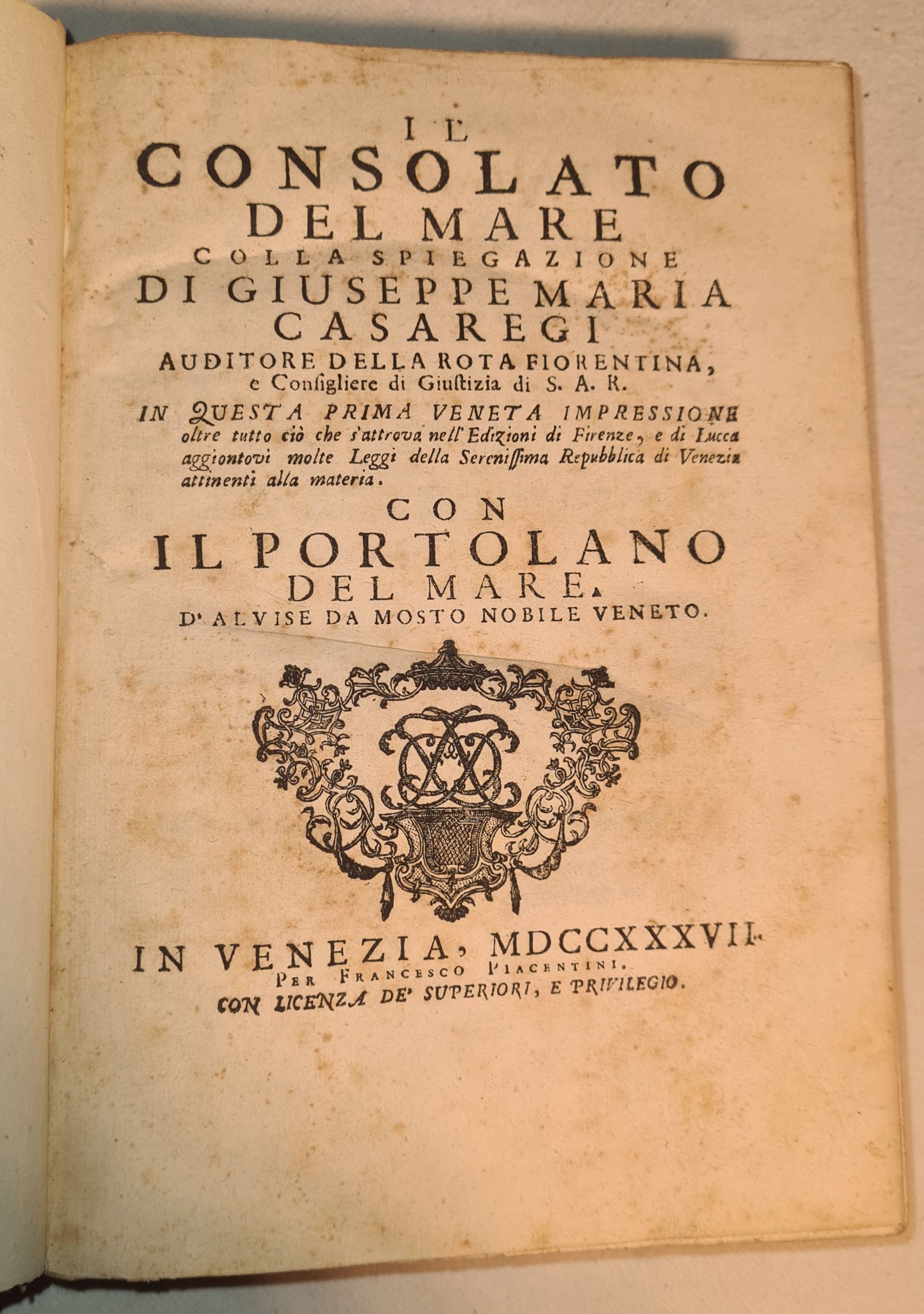
The Consulate of the Sea
With an explanation by Giuseppe Maria Casaregi: in this first Venetian edition, in addition to everything found in the Florence and Lucca editions, he adds many laws of the Most Serene Republic of Venice pertaining to the subject. With the Portolan of the Sea by Alvise da Mosto, a Venetian nobleman. Venice, Piacentini Francesco, 1737.
Author: Casaregi Giuseppe Maria
In 4° antique, they are two volumes in a full leather volume, with the title on the spine label.
Volume I: 10 cc-nn. 484 pp. 19 cc-nn. XLI pp.; Volume II: 68 pp.
This Venetian edition of a classic of commercial law is highly interesting, featuring notes by the renowned jurist Casaregi, the Portolan of the Sea by Alvise da Mosto, and the addition of the Parties adopted in the Most Excellent Council of Pregadi. It also includes various laws taken from Book Six of the Statutes of Venice regarding ships and their navigation.
Read more
Consulate of the Sea: title of a textbook on maritime customs of the Mediterranean basin, compiled in Barcelona in the second half of the 14th century. It is the work of a private jurist, who collected the customs that gradually developed among seafarers who frequented the ports of Spain, Italy, and France. The influence of Italian maritime law, especially Amalfi law and the customs of Pisa and Genoa, is particularly notable. The text is written in a Catalan-style dialect. It is of great importance for the history of maritime law, both for the breadth of the subjects it covers and for the widespread influence it rapidly acquired, supplanting all other relevant legislation and thus laying the foundation for a common maritime law of the Mediterranean.
Casaregi Giuseppe Lorenzo Maria. A famous Ligurian jurist, born in Genoa in 1670 and died in Florence in 1737. He practiced law and taught civil law in Genoa. Auditor of the Rota and counselor of justice first in Siena, then in Florence, he is considered one of the founders of modern commercial law. His Discursus Legales de Commercio, a collection of dissertations and opinions on commercial and maritime matters, have enduring fame. Among his other works are Il Cambista istruito per ogni caso de' fallimenti (The Cambist Instructed for Every Case of Bankruptcy) and the commentary on the Consolato del Mare (The Consulate of the Sea).
General Customs of the Duchy of Aosta
Proposed and drafted; in writing in the Assembly of the three Estates, Churchmen, Nobles, Practicians, & Customary Law. Together with the customs and styles observed in the said Country. All reviewed and corrected, and approved by His Highness - Second edition
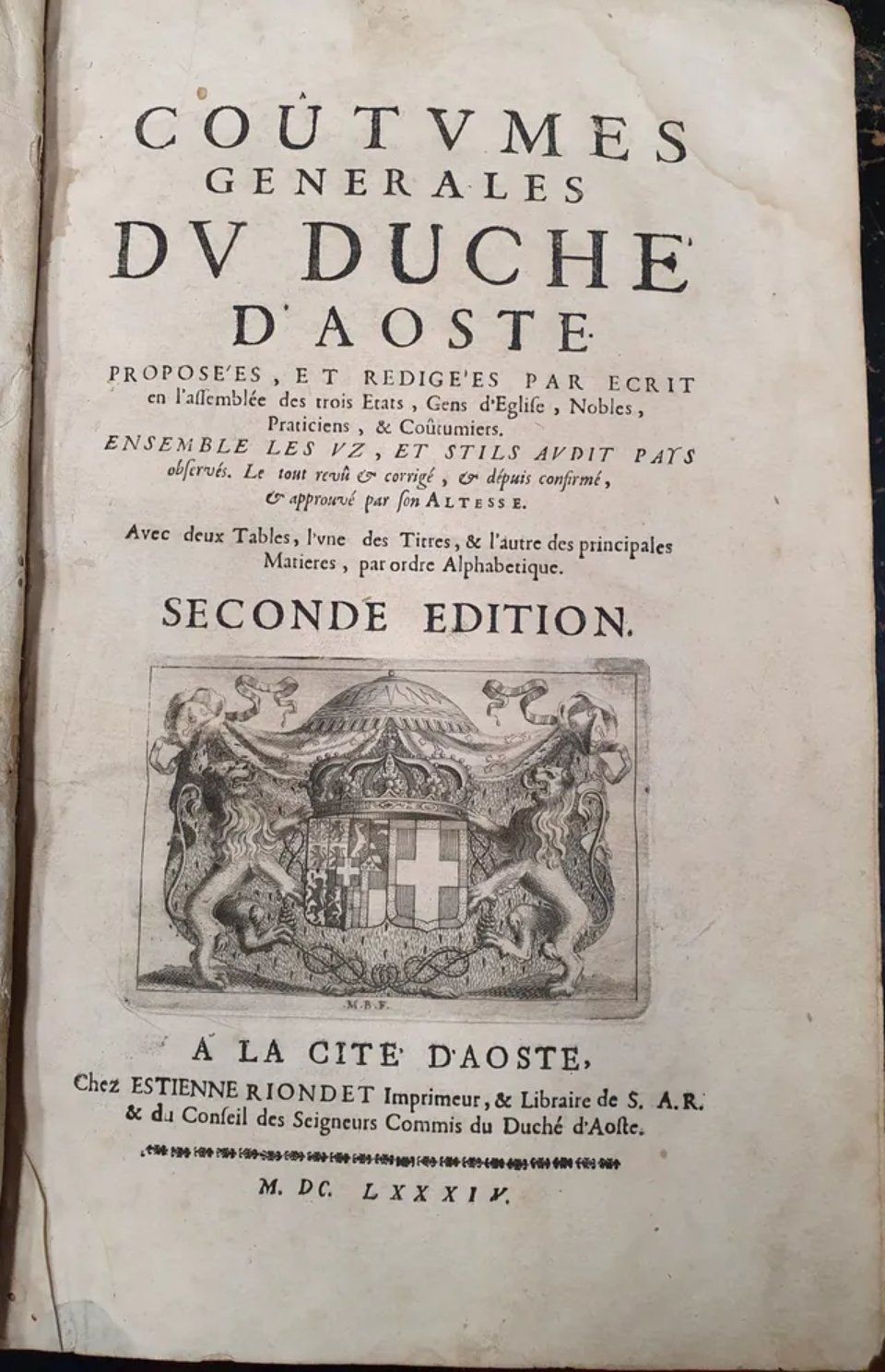
In folio, pp. (8), 833, (111), contemporary full brown leather binding. Large Savoy coat of arms engraved in copper on the frontispiece, initials and syllogisms. Second edition, printed in Aosta, by the famous coutumier (the 1st edition had appeared in Chambery in 1588), equally rare and sought after. It contains the Statutes and laws issued for the Aosta Valley; pp. 824-6 contain the particular laws for the Cogne Valley. A work of notable importance for the civil history and customs of the Aosta Valley and of notable rarity.
Beautiful edition in excellent condition.
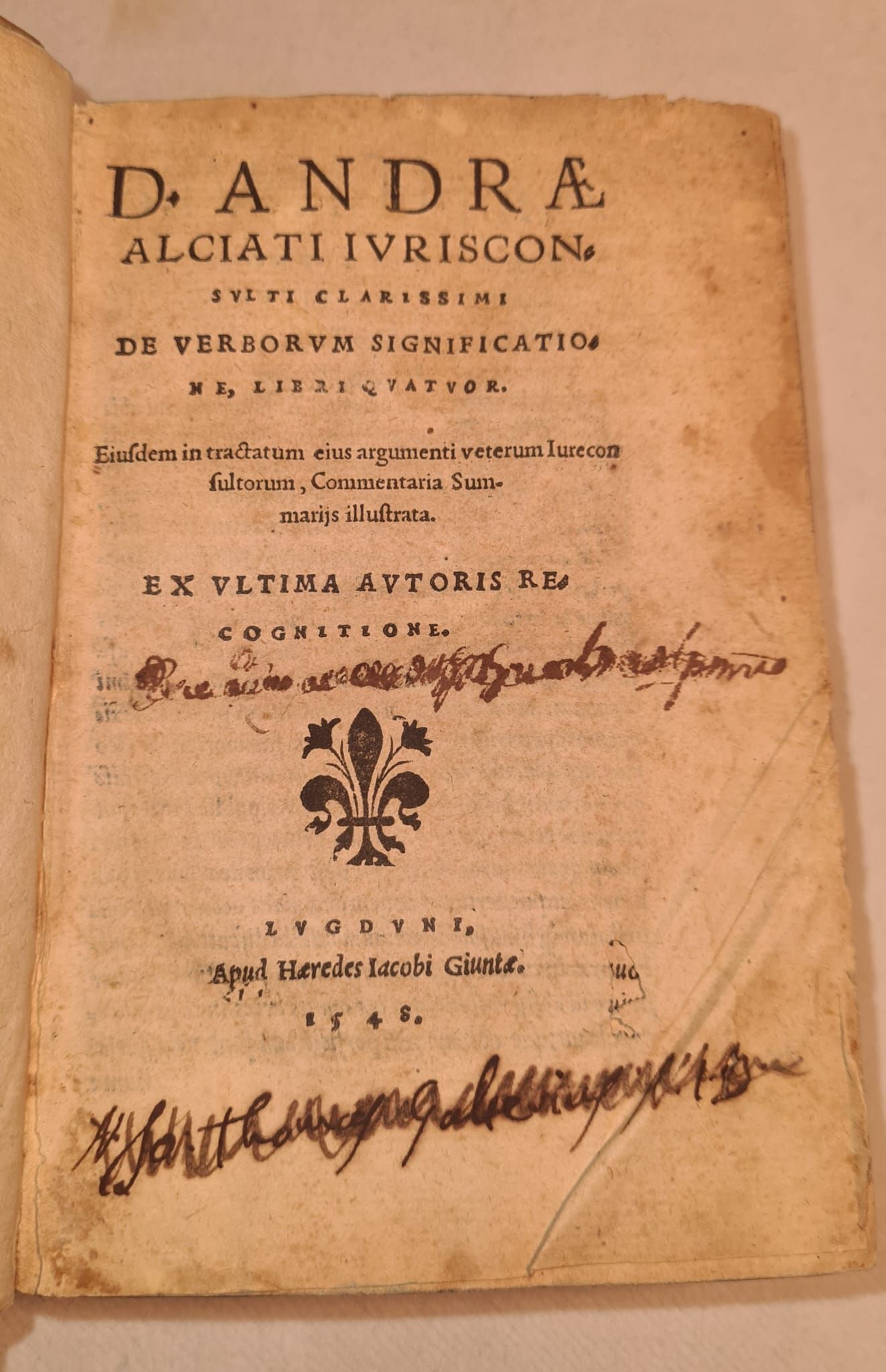
Andrea Dr. Andreae Alciati, the most illustrious jurist, On the meaning of words, four books
Andrea Mr. Andreae Alciati iureconsulti clarissimi De verborum significatione, libri quatuor. Eiusdem in tractatum eius topics veterum iureconsultorum commentaria summarijis illustrata ex ultima autoris recensione. Lugduni, apud haeredes Iacobi Giuntae, 1548.
By the author: Andreas Alciato
1 volume in 8th ( Pp. 222, (2) bb., 587, (111), index
18th-century full parchment binding with leather binding and gilt title and decoration on the spine. Light, even browning and ancient glosses and underlining in the text.
Read more
Andrea Alciati (1492–1550) was a humanist and jurist renowned throughout Europe. He taught in Avignon, Bourges, Bologna, Pavia, and Ferrara. Andrea Alciati (May 8, 1492–January 12, 1550) is considered the founder of the French school of humanist jurists. Alciati was born in Alzate Brianza, near Milan, and settled in France in the early 16th century. He demonstrated great literary skill in his exposition of the laws and was one of the first to interpret civil law through the history, languages, and literature of antiquity, replacing the servile interpretations of glossators with original research. He published many legal works and some annotations on Tacitus, and amassed a collection of Roman inscriptions from Milan and its territories as part of his preparation for his history of Milan, written in 1504–05.
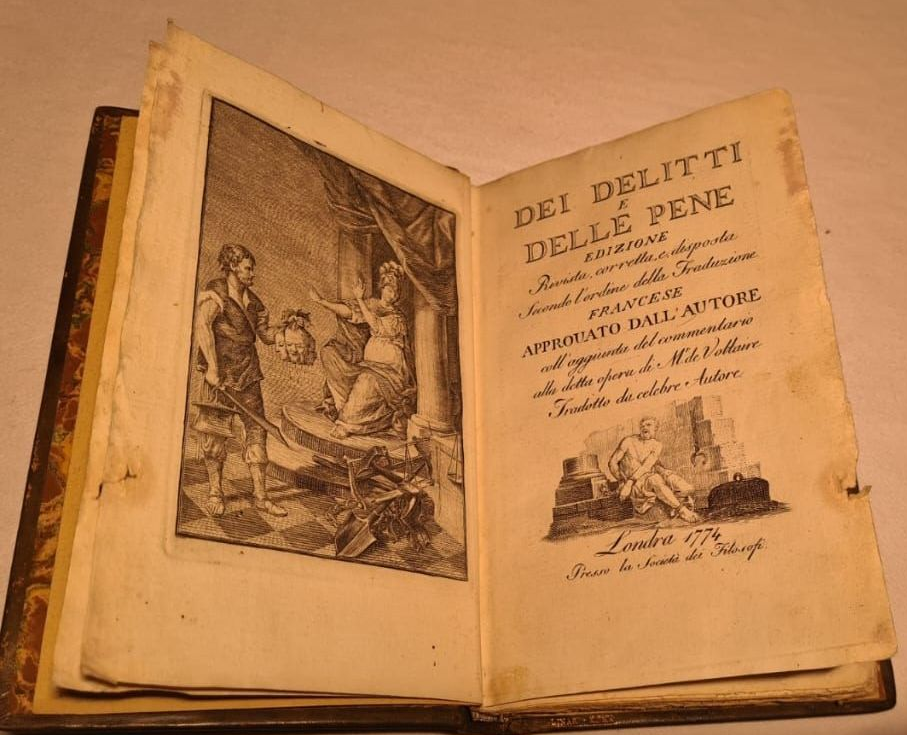
Of crimes and punishments
Edition Revised, corrected, and arranged according to the order of the French translation approved by the Author with the addition of the commentary on the said work by Mr. de [sic] Voltaire. Translated by a famous Author. London [but Livorno]. Published by the Society of Philosophers [Tip. Coltellini di Giovanni Masi], 1774.
Author: Cesare Beccaria
Publisher:
First Italian edition rearranged according to the Morellet edition
Excellent example, very fresh.
1 c. with inc. on the frontispiece, pp. [2] XV [1] 167 [1], modern full leather binding with gold title on the cover. First Italian edition with the text no longer divided into 47 chapters, but copied on the layout of the French edition edited by Morellet, with 42 chapters and the reorganization of the material according to the outline of a legal treatise (an arrangement that will remain in vogue in the common language until the beginning of the 20th century).
Read more
Called the "London edition," it was probably edited by the young Gaetano Poggiali. The allegorical plate on the frontispiece is very beautiful, "it was newly engraved, faithfully following Lapi's original model; the entire frontispiece was engraved on a copperplate of the same size, and at the bottom it bears a vaguely allusive vignette depicting a bearded, half-naked prisoner bound in chains at the base of a column" (See Firpo, Le Edizioni dei Delitti e delle Pene, 16 and pp. 508ff.).